What is AAC · augmentative and alternative communication
What is AAC (augmentative and alternative communication)?
Millions of people can’t rely on speech — because of autism, cerebral palsy, apraxia, a stroke, or ALS. They have just as much to say. AAC is any method that gives them a reliable way to say it.
The principle at the heart of AAC
Feel it
Say it without your voice
Content warning: a simulation of being in pain and unable to speak, with sound. You’re in pain and need to tell someone — but you can’t speak. Build the sentence by tapping. Notice the effort.
A speaking person says “I need help, I’m in pain” without a thought. Try saying it with taps alone.
An honest, gentle simulation — not the full reality of living without speech. Press Begin when you’re ready.
What AAC is
A reliable voice, by another route.
Augmentative and alternative communication (AAC) supplements or replaces spoken speech — from low-tech picture boards to apps that turn symbols or text into spoken words. People who use AAC may be nonspeaking or minimally speaking for many reasons: autism, cerebral palsy, Down syndrome, apraxia, ALS, aphasia.
The most important thing to understand: AAC doesn’t create the thoughts. They were always there. It gives them a way out. Not speaking with your mouth is not the same as having nothing to say.
What people feel
The stakes aren’t convenience. They’re dignity.
Imagine being unable to say “I’m in pain,” “stop,” “I love you,” or “that’s not what I meant.” For AAC communicators and families, communication isn’t a nicety — it’s autonomy, safety, and being known.
Families describe the emotion of a first sentence spoken through a device, and the daily frustration of being underestimated by a world that confuses speech with intelligence — and the fight to get a dedicated device at all, where repeated insurance denials before approval are common.
By the numbers
Exactly what it does — and doesn’t
What it does
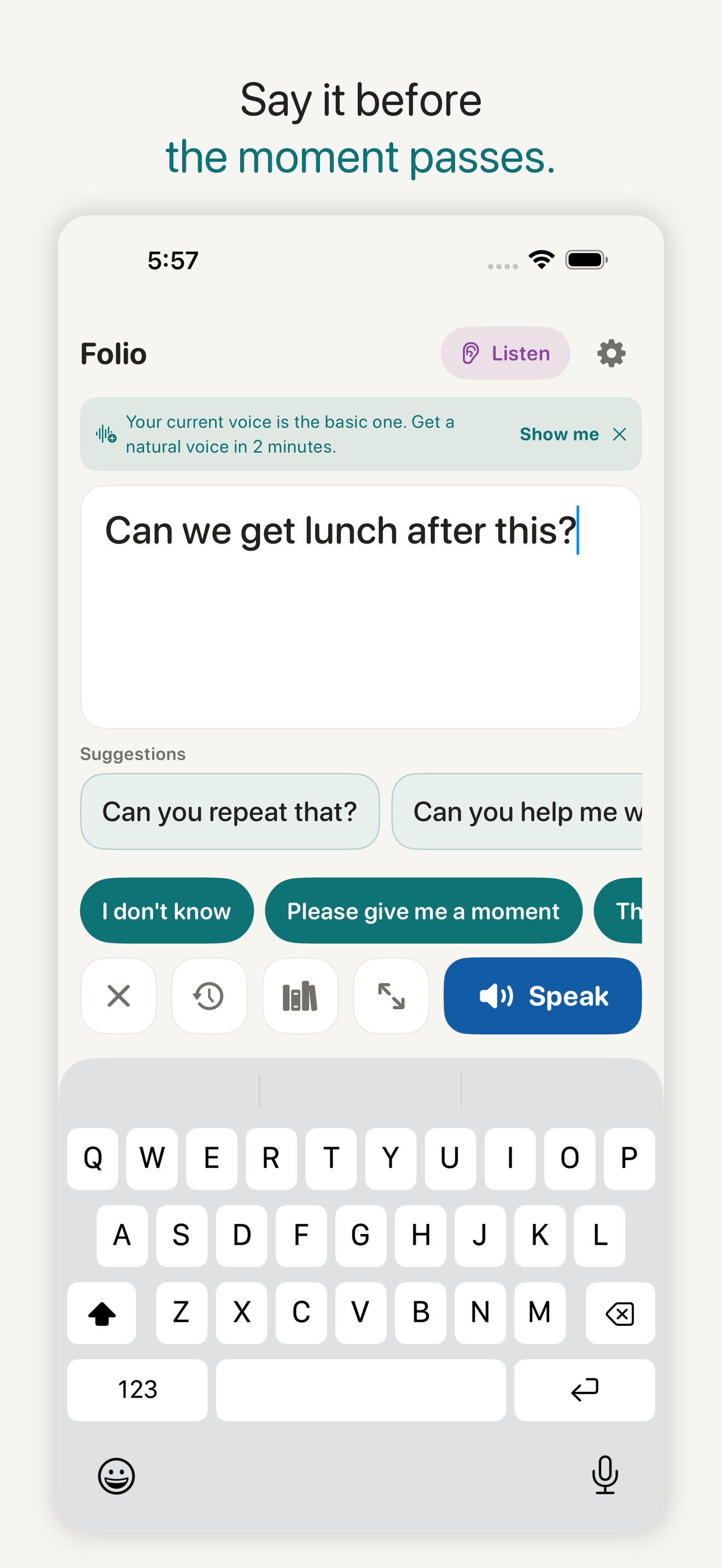
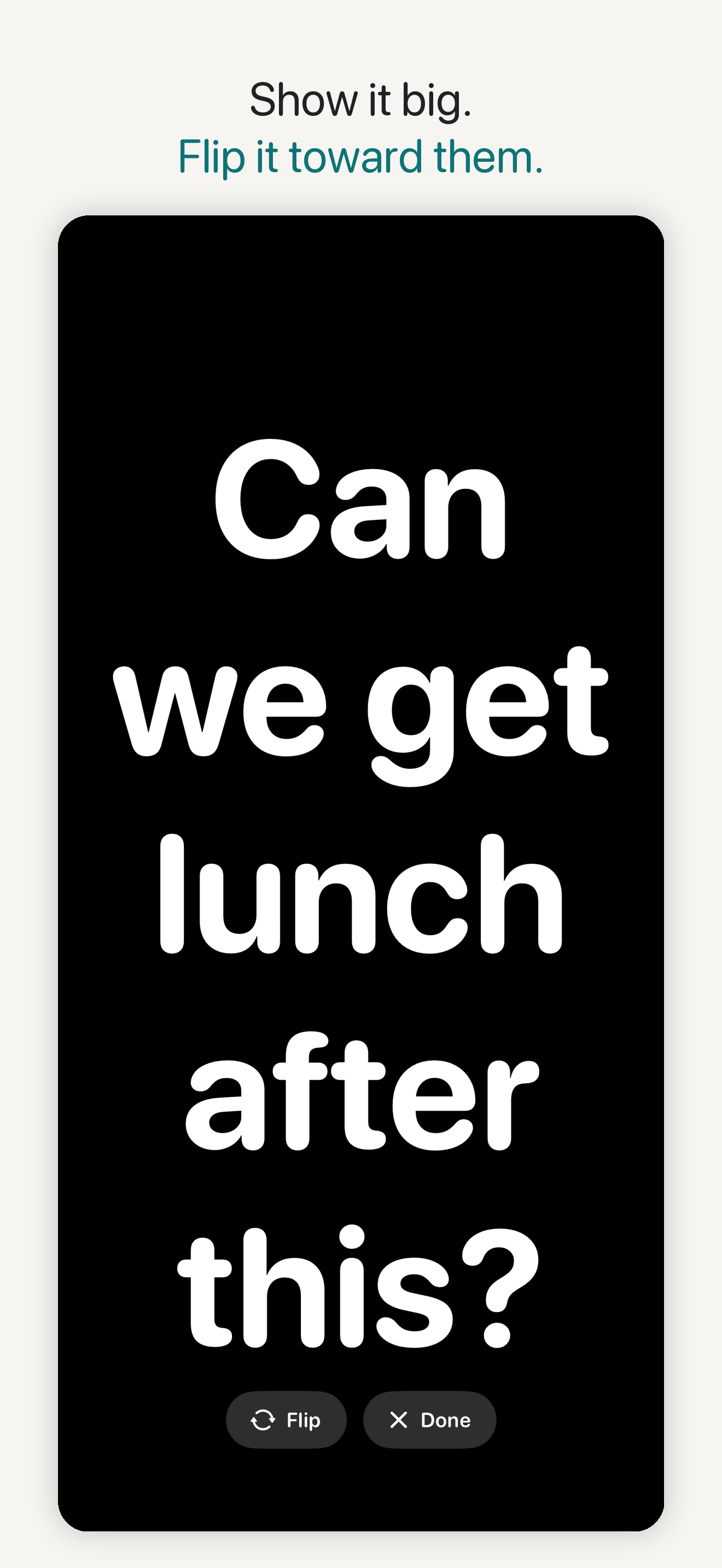
Folio turns typed messages and saved phrases into spoken words, out loud, the moment the person types or taps.
How it works
It speaks the words the person types or taps. It never speaks or inserts anything they didn’t choose.
What it is not
A text-based talker for people who read and type — not a symbol AAC system for pre-literate children, not a clinical AAC evaluation, and not a replacement for a speech-language pathologist where a family wants one.
The app
Folio AAC
A talker for people who type to speak — type a message or tap a saved phrase, and it’s said aloud, even in your own Personal Voice.
Folio sidesteps the thousands-of-dollars hardware barrier and the months-long funding fight as an immediate, accessible path to a voice for literate communicators. Speed matters because real conversation moves quickly — Conversation Mode suggests full replies, on-device, before you type. A design the user actually likes matters because dignity is part of communication. It speaks their words — it never decides for them.
Free to use. Any optional upgrade is shown in the App Store before purchase.
Setting up AAC at school? See AAC and assistive apps in the classroom.